This is what would happen if taxes were payable in any currency?

Beyond all the free market reforms I will spearhead as a Knesset Member, first and foremost will be a free market in money itself. Technically, the solution is extremely simple: Allow Israeli taxpayers to pay their taxes in any currency they choose, even the shekel if they choose. This would make any currency legal tender de facto, and would end the Bank of Israel’s monopoly over the shekel supply.

In order to understand why this is so necessary and exactly why it would free the economy so effectively, we need to understand how and why a monopoly on money creation by the Bank of Israel is so destructive, why it makes the middle class poorer continually, and precisely why it causes the boom/bust cycle.

Cars as an example: The Money Printer vs the Money Saver

Imagine for a moment that I want to buy a car for 100,000 shekels. I’d rather not work and save, so instead I decide to simply print 100,000 shekels in cash so I can buy the car. I print it, I hand the money over to the car dealer, and the car is now mine.

What just happened here? I counterfeited 100,000 shekels and increased the money supply by 100,000 when I handed those shekels over to the car dealer. The average person, the kind that has to work for his money would say that I stole 100,000 shekels. But today’s economic experts like Stanley Fischer and Ben Bernanke and Paul Krugman would say that I gave “economic stimulus to the automobile industry.” So what really happened?

When an average person works in the private economy and saves money to buy a car, he produces more than he consumes, hence savings. In other words, he puts more into the economy than he takes out, the difference represented by the money he saves. There is now more value in the economy, more stuff because he worked harder, and he takes that real value represented by the money saved and buys a car for 100,000 shekels.

The car dealer now has 100,000 shekels of real value to invest in expanding his business, and thanks to the value that the saver added to the economy through saving, there is now more value in the economy with the same money supply. The value of the shekel goes up and prices drop just a little bit, and everyone owning shekels gets a bit richer thanks to the saver. The car dealer can now expand his business and safely assume the demand is there to match his increase in supply. The economy grows.

Now, if I simply print up 100,000 shekels and give it to the car dealer, I added zero value to the economy. There is no more useful stuff. Just paper. I did not save a thing. All I am doing is taking from the economy without adding anything to it. Worse, the 100,000 shekels I added to the money supply makes the value of the shekel go down a little bit, since more shekels are now chasing the same amount of goods. Prices go up. Everyone gets poorer, except for me of course, because I got to buy the car before the money supply went up. The act of me buying the car was itself the action that made the money supply go up in the first place. I, the money printer and the first new money user, am up one car. Yay for me. But everyone else besides the first person to use newly printed money loses.

Now, let’s say I stop printing money and the car dealer expands his business with the new shekels. Since everyone is now poorer, there is no new demand to match his new supply. The signal he got of new demand for his cars was wrong, because the 100,000 shekels I printed did not represent added value to the economy through saving. Demand is not there, his business overexpands and he has to cut back and contract by selling cars for cheaper and taking a loss. His business shrinks or “goes into recession”, but cars get less expensive for everyone else.

But let’s say I keep printing 100,000 shekels every day and buy another car with it day after day after day. The car dealer will keep misinterpreting the sales as new demand that doesn’t actually exist. He will keep expanding. It will look like the economy is growing and growing, the statistics the government puts out on car sales will skyrocket. But really, only I and the car dealer are benefiting. Everyone else is suffering inflation and getting poorer and poorer every time I print. At some point I will have to print more than 100,000 to buy each car since the money supply is expanding so rapidly, but that’s no big deal for me. It takes the same effort to print 150,000 as it does to print 100,000. I keep getting richer. Inflation doesn’t bother me. The car dealer keeps expanding and cars become so expensive that no one can buy them. Then let’s say suddenly I stop printing shekels and stop buying cars. The car dealer’s business totally crashes, and he goes out of business in a bankruptcy sale. All the cars get sold to the public for ultra cheap. His business “goes into depression,” but cars are suddenly cheap for everyone else.

So we see that every time money is printed:

  1. The ones who receive it first are the ones who benefit the most
  2. The ones who receive it first also become entirely dependent on it
  3. The ones who receive it last suffer inflation and a rising cost of living

And we see that every time I stop printing money:

  1. Those who were receiving it first, suffer the most
  2. Everyone else benefits from deflation and a falling cost of living

What happens in reality?

But this is not exactly how it happens in reality. The institution in charge of printing shekels, the Bank of Israel headed by Karnit Flug, does not “stimulate the automobile industry”. No no. That’s not her job, at least not directly. When Flug expands the money supply, she buys none other than government bonds with printed money and stimulates the government. The government is always the first to get the new money.

The government then puts most of the money into the banking system, and uses a small tiny percentage of it to hire more government ministers in order to satisfy coalition partners, give raises to government workers in order to keep up with consumer prices (because God forbid a Knesset Member should suffer the ravages of inflation), cave in to unions like the Histadrut when they threaten a general strike which gives them even more power to shut the country down in future spats, and pass out more welfare to the four corners of the Earth to get more voters. So the first ones to receive new money from Fischer are:

  1. The government and its workers
  2. The banks

Who is the next in line? After buying votes and coalition stability with printed money, the banks then take most of the money and invest it in the stock market and mortgage loans. So the next in line are:

  1. The stock market
  2. The real estate market

As the real estate market rises, so do rent prices, effecting the middle class wage earner who can’t afford to buy a house and who is always last to get the new printed money. Meanwhile the government and the banks expand blissfully, and the stock market goes up, but you don’t have enough money to invest there because, with inflation and rent and food going up, you are going into debt. To the banks of course.

And so it goes, that every time the Bank of Israel prints money, the government and the banks and the land owning government-connected tycoons get richer and the middle class gets poorer. The wealth transfer from middle class to rich is a necessary part of this process. Why? Because if, for example, the Bank of Israel wants to raise the money supply by 5% and instead of giving the money to the government and the banks, it simply adds 5% to all of our bank accounts overnight, the prices of everything would go up 5% in a day or two and the Bank of Israel would have accomplished nothing but stark and immediate price inflation. The trick is to give it to one group and its buddies, being the government and the banks first. That way it takes time for inflation to affect prices and people don’t even realize they’re getting poorer, or if they do, why it’s even happening.

In order for it to work, the inflation it has to be slow and insidious so people don’t even realize what’s going on. It has to look something like this:
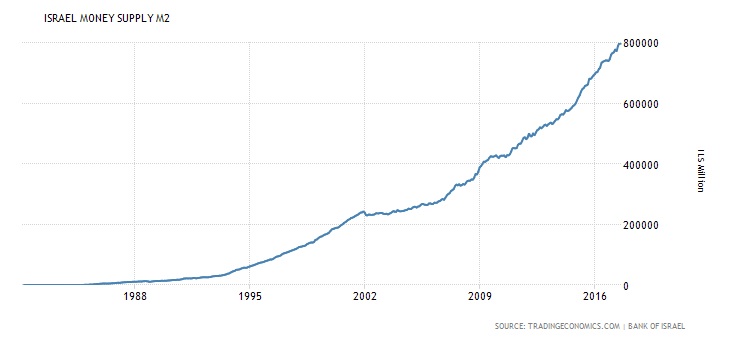
It has to take place over years and decades, so suddenly 50 years pass and people wonder why it now takes 2 salaries and 30 years to pay down a mortgage instead of 20 years and 1 salary, like it did 50 years ago. And then innocent people led by ignorant populists suddenly go out in the streets and protest, but they don’t know what to demand in order to fix it. Just that the government “do something,” like print money and hand it out or something.

Why is this happening? It’s because your money is losing more and more value every year while your wage grows at a slower and slower pace. You are not a government buddy, so you never get the new money first. Every time money loses value, the politically connected get richer, because they are always the first ones to get the new batch first. Government, banks, stock market, real estate.

If you want to blame someone for the cost of living going up and your paycheck staying flat, someone to blame for the rich always getting richer and the middle class always shrinking, blame paper money and the Bank of Israel, and the government for forcing you to accept its garbage money by forcing you to pay taxes with it. The Bank of Israel has destroyed savings entirely once before.

Inflation is always, always bad, because the effect is cumulative. Inflation of 1% one year does not “make up” for inflation of 4% the year before. If prices go up 4% one year while your paycheck only goes up 2%, you now have 2% less purchasing power. If the next year prices only go up 1% and your paycheck only goes up .5%, you lose another .5% purchasing power in addition to the 2% you already lost. It only gets worse. Every year. And the losses keep adding up for the middle class. You are being robbed. Every year. All the time.

Eventually the wealth transfer will become so extreme that the system will collapse. It is inevitable. Unless we act to fix it, right now.

The Solution: Competing Currencies

If taxes are payable in any currency, the Bank of Israel loses its monetary monopoly. If it prints too much, the value goes down relative to other currencies and Israelis will prefer earning those currencies instead and the bank will have to cut back on its printing or stop it entirely in order to support the shekel’s value. If Israelis can pay taxes in dollars, euros, gold, silver, bitcoin, whatever, they can then earn those currencies and they can start circulating in the Israeli economy.

Competition breeds honest money, and the middle class always gets stronger. How? Because with honest money, the money supply stays constant or increases only very slowly, but the supply of goods in the economy grows much faster, so everything gets cheaper over time.

To give you one stark example from the United States, over the last 50 years, the price of a house in dollars has risen 780%. But the price of a house measured in ounces of silver has actually dropped 64%. What about the middle class wage earner? The average wage in dollars has gone up 766%, but the amazing thing is that, in ounces of silver, or real purchasing power, the average wage has dropped a dramatic 65%. In other words, it looks like wages have increased, but there is actually 65% less purchasing power even in that increase. That’s how insidious inflation is. It looks like you’re gaining but you’re actually losing. The middle class and the poor always lose with monopoly (literally, not the game) money, but they would gain with free market money.

The way to do it so make taxes payable in any currency, thereby making any currency legal tender, and breaking the government’s monopoly on the money supply.


Conversations with a Statist: Round 1, “Free Medical School”

It’s a dumbfounding experience speaking to a man who really believes that the State exists to take care of people, that it is trustworthy, that if only some law were passed so taxpayers could fund just one more thing, everything would be fixed.

The statist believes in force. He believes in laws. He fears liberty. He thinks it will lead to chaos. He does not trust the market, he has a low view of man, but paradoxically, believes a man-run State is somehow exempt from the low status of mankind he has bestowed upon the tax paying portion of the population. The tax parasites, those are the noble ones, living off the productivity of others like leaches.

In one conversation with a statist who is some sort of researcher or teacher at a medical school , I accused him of supporting taxpayer subsidies because he is part of the two most heavily subsidized industries – healthcare and higher education. He responded that most of his money comes from “private research grants” rather than tuition from indebted students that get their money from government loans. There’s always a way to weasel out and say you’re clean.

Private research grants probably from Big Pharma companies that have spent millions lobbying congress for extra regulations and hoola hoops and barriers for smaller companies from entering the industry. Let’s see one small cap company successfully break through the insanely expensive phase III FDA barrier without Big Pharma lending a “helping hand” and securing revenues for itself. Private research grants…fah. What he means is research grants given by huge conglomerates that have special corporatist privileges from government.

He’ll read this, deny it, say the money is clean because it comes from pure capitalists who are not in bed with government, which will then contradict his whole value system because, of course, he is supposed to love government and hate pure capitalists as greedy pigs.

Anyway, he suggested that the best way to eradicate student loan debt is to…get this…make medical school… “free”. What genius. Here is how I responded to that wonderfully ingenius proposal:

With what money are you going to make medical school free? Who is going to pay for it? The Feds, who are in the hole over $100,000,000,000,000 in unfunded liabilities? This is what I can’t understand about about you people and it brings me almost to tears. Don’t you get it? There is no more money. It’s all gone. How the hell are you supposed to make medical school free? The answer is you force people who don’t want to go to medical school to subsidize people who do want to go to medical school, more theft.

You say the trillion dollar student debt is unfair, and they you have the chutzpah to suggest free medical school? Do numbers mean nothing to you? Or do you just ignore them? Does your brain turn off when you hear the debt? Do you think it’s fake?

What do you think is going to happen when the debt cannot be paid? All the trillions of dollars of treasury bonds are going to flood American shores. The dollar will collapse completely. All your savings will be wiped away in a few months. You won’t even be able to afford to buy food and clothing, let alone “free medical school”. My God. You can’t see it. You think money is pieces of paper.

Go ahead, enjoy your free medical school. The debt is just a fairy tale after all.

Here is his Statist response:

“With what money are you going to make medical school free? Who is going to pay for it?”

That you ask the question shows that you don’t know how the US health care system works, or the numbers involved. The total cost would be under $5 billion annually. The savings from a single drug — Lipitor — going generic would have paid for it. And it would dramatically reduced costs in the long run.

“more theft”

As I pointed out, taxes aren’t theft. Period.

“Do you think it’s fake?”

About 40% of it is in fact fake, as the US includes debt held by government agencies in the national debt calculations. If you eliminated the national debt as it is typically defined, you would also eliminate 96.5% of the US currency in circulation, which would be catastrophic for the entire planet.

“What do you think is going to happen when the debt cannot be paid?”

The only reason the debt won’t get paid would be if the Republicans refuse to raise the debt ceiling or shut down the government. Japan’s national debt as % of GDP is more than double that of the US, and nobody is ranting the way you are about its solvency. The problems in the US are political, not fiscal or economic. And attitudes such as yours are a major part of the problem.

So let’s break down this bull.

First paragraph:

That you ask the question shows that you don’t know how the US health care system works, or the numbers involved. The total cost would be under $5 billion annually. The savings from a single drug — Lipitor — going generic would have paid for it. And it would dramatically reduced costs in the long run.

That you answer the question this way shows that you don’t know how the US government system works or the numbers involved. The total cost would be advertised by politicians as under $5 billion annually. They would say things like “the savings from a single drug going generic will pay for it! And we’ll have dramatically reduced costs in the long run!”

I can picture some senator saying that right now. It would sound beautiful. Just one more law will fix EVERYTHING! I know where I’ve heard that line before. From FDR, when he started Social Security. Huge savings. Little cost. Nothing to worry about. And LBJ when he started Medicare. Huge savings. Little cost. Nothing to worry about. And George WTF Bush when he wanted to bomb Iraq. Little cost. In and out. Huge oil savings. Nothing to worry about. Now both programs encompass HALF THE ENTIRE FEDERAL BUDGET OF OVER $3 TRILLION DOLLARS. And Iraq cost over $1 trillion MORE.

You know what’s going to happen when medical school becomes “free”? Here’s what would happen.

The government would be ecstatic that it now has a whole NEW chunk of the economy, medical schools all over the country, under its tight satanic grip. With all the money now in the hands of disgusting politicians trained to squeeze money out from wherever they can, Senators from states with “underprivileged medical schools” would get lobbied to increase the taxpayer funded budget for the medical school in their state. Commercials from doctors unions would be run “decrying the horrible state of medical education” and there’d be an emergency 2am vote in the Senate to double the national medical school budget and make sure our “national medical education infrastructure remains safe for future generations.” Then inside that bill doubling medical school spending, you’d have 50 porkbarrelled riders adding gyms and saunas “off budget” to the medical schools where you have the most relatives of senators.

Then you’d start the campaign to expand the medical school student population for the underprivileged, inner city poor kids who have no shot of getting out of the ghetto unless they go to medical school. We have to include all of them, so we have to expand the budget. Let’s double it again and bring in at least 30% minorities. Any medical school that doesn’t bring in at least a 30% minority student base has its budget cut and subsequently spent on the next stupid “War on Terror” horror episode. Any school that brings in a higher percentage gets increased funding.

A huge government contractor now wants a new project. He has a friend high up in some medical school close to Washington. The friend wants to give the contractor a job building a new platinum encrusted wing in memory of some politician’s great niece to a medical school. So the friend says to the government that without a new wing that will cost at least $30,000,000, the quality of medical education at his institution will decline precipitously. He knows the exact man for the job. Ride it onto some spending bill. Sounds good.

Soon all the medical schools want new wings dedicated to more politicians. The budget balloons.

And so on and so forth. $5,000,000,000? And how much was social security and medicare supposed to cost? $1.6 trillion of course. And counting. Feh.

Savings. That’s what the government wants to do. Save you money. That’s why they’re the most indebted institution to ever have existed on planet Earth. Because they want to save you money, that’s why. Perhaps it’s because they like spending money they extract from you? Just a thought.

Why even get into the aspect of inter-government debt and it being a fiction? He doesn’t understand what debt is. According to him, since the government owes the government, it’s all fake. Ha, that’s a good one.

Here’s a reductio ad absurdum. Joe of planet Earth owes Bob of planet Earth $16 trillion dollars. But since they’re both of planet Earth, Earth owes it to itself, so the debt is fiction.

Sounds good to me! Let’s keep spending! And as long as we can keep upping the debt ceiling and borrowing more money to pay off money we already borrowed, everything will be fine! Nothing’s going to crash! This isn’t some sort of positive feedback loop! Interest rates will stay at historic lows forever! Nothing to see here! Just keep spending!

PEACHES AND CREAM!

Give me the Bank of Israel and I’ll destroy it

In response to one of my posts on the Manhigut Yehudit listserv, of which I am a frequent commentator on free market issues, one of my allies responded with the post, “Rafi Farber for Finance Minister!”

To which I responded thusly:

I don’t want the finance ministry. I want the Bank of Israel. Let me be BoI Chairman in the Feiglin administration and I know exactly what I’ll do and how. Without the Bank of Israel printing the money and creating inflation, the Finance Ministry is completely castrated, and it will have to raise taxes like crazy in order to fund all the waste and welfare, which would be impossible to do without endangering the regime itself. The government will be forced to either shrink down or risk a revolution.

Give me the Bank of Israel, and within a year I will sell almost all the dollars and the rest of the foreign exchange, buy gold and silver, hand it out to every bank in proportion to how many shekels each bank has on its books, tell them that they are now all completely on their own, close the BoI doors, fire everyone who works for me, resign, and call it a day.

Whew! Wouldn’t that be awesome. I salivate and get teary eyed just thinking about it. I’d need to hire a bodyguard.

Stanley Fischer deserves not one iota of praise

This man is no hero.

Stanley Fischer is the head of the Bank of Israel. As such, he is the government appointed goon in charge of money printing. In his infinite wisdom, he is supposed to know exactly what the supply of money should be, because he’s purportedly a chacham she-ein kamohu – a crazy genius who has a pulsating brain and somehow knows these things. Or maybe God comes to him in his sleep and tells him how many shekels should exist and how much he should print and when.

Or maybe he’s just some guy who has no idea what he’s doing, given a power the equivalent of an economic nuclear weapon, something that no one man should ever, ever have.

Stan the Super Shekel Man recently came out with an announcement that he would be quitting his post early. Aside from the speculation as to why (I think it’s because he knows there will be an unstoppable economic tsunami in the next 3-5 years and he wants to duck out early and quit while he’s ahead), I have seen nothing but wall to wall praise for this central planning money printing soviet-style currency czar. Sure he’s kindly, has a sweet voice, an endearing Zambian accent, cutely mixes up male and female in his Hebrew grammar all the time, and the Israeli economy didn’t totally collapse in 2008 so everyone assumes the money master is responsible for saving us all from destitution. But this is all a big, sad, sorry myth.

Let’s break it down.

Let’s step aside for a moment from the persona of Stan the Man himself. He as a person is not the main problem. As I said, he’s a nice guy. The main problem is the very system of central banking that give men like him inordinate power over all of our economic lives, a power which, once you realize the scope and consequences of it, can make you dizzy.

Imagine for a moment two national economies. One where the supply of shoes and their price is controlled by one man and anybody else who manufactures or uses shoes besides him goes to jail, and another where the supply of shoes and their price is controlled by the free market, meaning a myriad of entrepreneurs freely importing and exporting shoes based on the demand for them by customers. In a free market where anyone can manufacture and buy as many or as few shoes as he wants, the supply, demand, and price of shoes will tend to reach an equilibrium point where profits will remain constant and steady. Shoe firms like wholesalers, manufactures, and retailers, will all compete with each other to sell the most shoes to the public. In order to do this, they will have to make shoes of the highest possible quality at the lowest possible prices in order to attract buyers.

If the supply of shoes gets too high, shoe prices will tend to fall, lowering profit margins, thereby restricting the amount of shoes manufactured, choking off supply, and bringing shoe prices back up to equilibrium. If demand gets too high, shoe prices will tend to rise, increasing profit margins, encouraging shoemakers to produce more in order to earn those increased profits. This brings supply back up to match demand, bringing prices back down to equilibrium again.

Now, in an economy where the supply of shoes and their price is controlled by one man, let’s call him the chairman of the Shoe Bank of Israel, we are entrusting a single person to:

  1. Manufacture every single shoe in the country, because anyone else who does that is considered a shoe counterfeiter and goes to prison
  2. Know automatically what the supply of shoes in the country should be at any given moment
  3. Set the price of shoes at whatever he thinks it should be
  4. Not abuse this power

The shoe market in such a country would be a complete mess and everyone who needs shoes would be miserable. Since only one firm would be allowed to make and sell shoes, there would be no competition and the quality of the shoes would deteriorate. If the Chairman of the Shoe Bank of Israel set the price of shoes too low, meaning he underestimates demand, people would start hoarding the shoes and buying more than they need, and there would be shoe shortages. If he sets the price of shoes too high, meaning overestimates demand, people who needed new shoes would not buy them, instead waiting for a lower price. Perhaps they would attempt to repair their old shoes, or cut open the ends if they didn’t fit. Huge surpluses of shoes would result.

Meanwhile, regardless of whether Stanley Shoemaker creates a shoe shortage or a shoe surplus in the country with his inaccurate divining of the appropriate shoe price and supply, people will have no choice but to buy shoes from him alone, and he will get richer selling them regardless of how crappy the shoes are. Nobody wants to be arrested for being a shoe counterfeiter after all.

Having one man in charge of the shoe supply in a country is bad enough. But it is infinitely worse to have one man in charge of the money supply in an entire country, because the supply and demand for money controls the entire economy, shoes included.

I know that the concept “demand for money” and “price of money” is hard to wrap your head around. Doesn’t everyone demand money all the time? How can it change? How can money itself have a price? Isn’t money money? Bear with me here.

It is difficult for people to understand these concepts these days because fiat government currencies have ruled the world since 1971, and governments the world over have taken upon themselves the exclusive right to produce money, forbidding anything else from entering the market as money. But in reality, money, just like shoes, is a good like any other. The only difference is that money is more easily tradable than shoes for other goods. In fact, money is the most easily tradable good that exists. That’s why it’s used as money.

Now, the “price of money” and the “demand for money” are reflected in many different ways. They are reflected in how much money money lenders (AKA banks) charge to borrow money, otherwise known as interest rates. If interest rates are high, then money is “expensive”. If money is expensive and money lenders can charge high interest rates, the “demand for money” must be high too. Otherwise, people would not be willing to pay such high rates in order to borrow money. If interest rates are low, then money is “cheap”. If money is cheap and money lenders are forced to lower interest rates in order to attract borrowers, then the “demand for money” must be low.

The price and demand for money is also reflected in the general economy in terms of the money prices of all other goods and services. At times when the demand for money is high, forcing interest rates up, that means people want to hold more of their money (AKA save) rather than spend it. If people want to save more money, the consequence is that the money-prices of goods and services will go down. Things will get cheaper to buy, because in order to attract sales, merchants will have to lower prices in order to entice more money out of savings.

The high interest rates, or high price of money, will in turn serve to bring the money market back into equilibrium at times when the demand for money is high and prices low, as money-savers (lenders) will earn higher rates of return. This will earn savers more money on their savings, and in that way they will be enticed to spend the money they earned from their saving, bringing prices back up, money out of savings, and interest rates back down as lenders are forced to settle for lower interest rates in order to attract more borrowers again. The demand for money is thus lowered, enabling merchants to raise the money-prices of other goods and services, prices go up, demand for money down, and interest rates down.

A short recap:

Demand for money up = interest rates up = prices down

Demand for money down = interest rates down = prices up

Eventually, this entire process reaches an equilibrium point where relative prices of goods and services in terms of money will stay more or less stable along with interest rates.

Now what about the supply of money? This is the cool part. In a free market, the supply of money will be controlled NOT by Stan the Shekel Man, but by gold and silver mining companies teaming up with private money coiners who in turn team up with private banks. Here’s how it works:

  1. Mining Company A has mined 100 kilos of silver, but needs them coined by a recognized and respected money coiner so he can buy stuff. Merchants don’t accept uncoined blobs of silver because there is no way to tell how pure the silver is. So he goes to Money Coiner B and gives him 100 kilos of silver.
  2. Money Coiner B puts the silver through his coining machine, checks its purity, and stamps it with his stamp of approval by coining it into little circles with his certification on it. He keeps 2 kilos of newly minted silver coins as a commission for his services.
  3. Mining Company A and Money Coiner B then go to Money Bank C and say, “Do me a favor Money Bank C. We have these coins here. They’re too heavy. Could you please put them in your vault and give us paper receipts that the silver is sitting here? Please give the silver to whoever presents you with the receipt.” Money Bank C takes the silver coins, provides them with receipts, and charges Mining Company A and Money Coiner B a small fee for storing the coins and providing the receipts.
  4. All parties go out and spend the paper receipts, AKA “money” in the economy and buy stuff.

How is the supply of money regulated in a free market? In the following way: When the demand for money goes up and the prices of other goods go down, mining companies will make higher profits on the gold and silver that they mine for two reasons:

  1. Since the prices of everything are going down, it will become cheaper for them to do the mining itself, increasing profit margins.
  2. Since the prices of everything are going down, the mining companies will be able to buy more stuff with the gold and silver they produce.

These two factors will entice them to increase production of gold and silver, increasing the supply, bringing interest rates down and prices of other goods and services back up. When prices of other goods and services go back up, it will cost the mining companies more money to mine gold and silver, and they will be able to buy less with the gold and silver they mine. Eventually, profit margins for the gold and silver they mine will go down to a point where they will be forced to lower production. The supply of money will go down and the prices of goods and services back down again with it.

In a free market for money, the best, most efficient, and most honest money coiners will get the most business and have the most coins circulating on the market. Those coining companies that cheat and lie about the purity of their coins will lose business and go bankrupt. Their coins will not circulate, or they will circulate at a discount.

In a free market for money, the best, most efficient, and most honest money receipt issuers (currency printers, private banks) will store the most money and issue the most currency. Those private banks that cheat and lie about how much silver or gold they have in their vaults to match the receipts and “inflate” their currency will lose business, inspire their receipt holders to call in their receipts for silver and if they can’t provide it, they will go bankrupt. Their currency will not circulate, or it will circulate at a discount..

In a free market for money, you will have several different competing currencies and coinages, with people accepting the ones with the best reputations and rejecting the ones that are unreliable.

Interest rates and prices will remain stable as money supply and money demand equilibrate, and as in any developed economy, goods and services will increase faster than the supply of money, allowing for a gently falling price level and everyone to get richer in real terms.

Or you can have someone like Stan the Shekel Man Fischer in charge, printing sheets of paper backed by absolutely nothing, causing prices to continually rise and government controlled money to continually lose value, making everyone poorer and more miserable.

Stanley Fischer did not save the Israeli economy from collapse. He simply did not abuse the insane power given to him as badly as other central bankers did: the monopoly power to print money. This power, incidentally, was given to him in much the same way as our fictional Stan Shoemaker’s was given to him: By a bully State ready and willing to arrest anyone besides Stan who manufactures shoes. Or in this case, money. And why would the Israeli government forbid anyone but Stan their goon from manufacturing money? Because when you have control over the entire money supply, you can spend it on anything…you…want. Like welfare. And leather seats for Knesset members. And armored cars for party heads. And first class trips to France for Defense Ministers. And subsidies to ignoramuses who you want to vote for you. And huge campaign posters and TV ads and God only knows what else.

When one man controls the shoe market, the quality of shoes goes down and everyone who wears shoes, suffers. When one man controls the money market, the quality of money goes down. It loses value. It makes you poorer.  Everyone who uses money, suffers.

Every single time Stanley Fischer printed shekels with the flip of a switch, he stole from people like you and me who have to work to earn our shekels. He stole from you. He stole from me.

Stanley Fischer is a thief who should be arrested. He is not a hero who should be praised.

The trillion dollar coin approach to middle east peace

There have been rumors and shmumors about America’s intention of minting a “trillion dollar coin” and sticking it in the Federal Reserve in order to bypass the so-called debt ceiling, which is more of a debt elevator. I couldn’t help but think of the Simpsons episode where the government prints a trillion dollar bill and Mr. Burns and Homer escape with it and somehow it ends up in the hands of Fidel Castro and the country survives on the wealth of the trillion dollar bill.

It is rare that I am dumbfounded, but this time I really am. I don’t know what to say. The mere possibility of the minting of a trillion dollar coin is so despicably absurd that I’m overloaded with a litany of potential sarcastic remarks that none of them can fit through the door of my mouth as they’re all crowding together simultaneously and are now jammed in the back of my throat and I can hardly breathe. Jon Stewart did a pristine job I must say.

Let me just start by saying that the source of this problem is that some primordial government, when it came in and seized the local mints and splayed the king’s face over all the coins, decided to give the monetary unit a proper name instead of a weight. For example, “dinars” instead of “ounces”. Then the Alice-in-Wonderland concept of “face value” was born, which doesn’t really exist. If instead of “dollars” the term for money was “grams” then money would be tied to weight instead of fancy shmancy names like “dollar” and the possibility of printing a gram of money or a “trillion gram coin” would be a lot more difficult for the government to do. So they had to rename the monetary unit to some imaginary term.

Two obvious questions are these, reductio ad absurdums, but it’s hard to engage in those when the premise you are attacking is itself so intensely absurd on its own:

  1. If you’re going to mint a trillion dollar coin, why not mint 16 of them and pay off the national debt?
  2. Why make it out of platinum? Why not elephant dung?

Better yet, you want mideast peace, right? And you love foreign aid and meddling. Then by God go all out! Why use it for such a petty thing as raising the “debt ceiling”? I say give the trillion dollar elephant dung to Israel, and then we can buy all of Syria, Jordan, Lebanon and Egypt and every single Arab in the country, pay them outrageous salaries to tap dance for us, and give them each their own personal trained pet chimpanzee to give them manicures and shiatsu massages and build them all gold-plated ivory mansions so they’ll be happy and won’t have to do anything after the daily tap dance for the Jews? Everyone over here will be rich, obviously, and therefore at peace. And the chimpanzee population will have a big boon.

There’s only one problem. How are we doing to break a trillion to get all this done? The local Five and Dime? Or the Five and Trillion?

And you want to use it to get around your stupid debt ceiling?

My Lord the world has lost its mind.

And don’t forget, there is nothing qualitatively different between a trillion dollar coin, and a one dollar bill.

How the free market redistributes wealth VS how the government does

Back in 2008 when I was still a Bill O’Reilly fan and a mainstream “neoconservative” type guy who loved the idea of spreading freedom with very powerful explosive devices throughout the world, I still didn’t like Barack Obama. It was on the Glenn Beck Program, who I am also no longer a fan of at all, that I heard some recordings of Obama talking on some radio show in Chicago about the failures of the Civil Rights movement in how they did not go far enough when they backed off from demanding court-ordered “redistributive measures”. Or something to that effect.

I specifically remember the word “redistributive” rolling off Obama’s silver tongue like a drop of glue-based dew on a glistening fake house plant shining in Vaseline basking in the artificial light of a sun lamp. It sounded so seductive and scary.

Go Glenn! I’d say.

Here’s how government redistributes wealth:

Government, benevolent and friendly and wanting to help the poor, seizes money by force from anything productive. Politicians take the money and start a welfare agency. The welfare agency provides paychecks for its bureaucrats, all of whom are friends of the politicians who seized the money. The benevolent welfare agency with the big heart runs out of money providing paychecks to all the bureaucrats running it before it hands out any stolen money to poor people, so the welfare agency lobbies for more money, which they use to expand the welfare agency and give more paychecks to more buddies of legislators, all of whom have huge hearts and went into the business of government bureaucracies to help poor people because they are so selfless. They run out of money again before they start doing anything, so they lobby Congress to steal more money from anything productive so they can do their job of eating paychecks more effectively, with huge big hearts of love and giving and benevolence.

With production down, there’s less stuff, making everything more expensive and hurting everyone’s standard of living. Then we are told that in order to increase our standard of living, the government needs more money.

A few months later, a welfare agency bureaucrat flips a quarter to a beggar on Capitol Hill, quintupling the amount of money given to the poor by the welfare system. The bureaucrat goes home all proud of himself for being such a selfless and giving human being and cashes his next paycheck.

The government runs out of money again, so they call on Ben Bernanke to print it, in the name of stimulating the economy.

Government thereby redistributes wealth from productive people to Congress’ best friends who out of the goodness of their souls, got jobs at a government welfare agency.

Here’s how the free market redistributes wealth:

Rafi and Natasha are paying 115 shekels a month in internet bills. Rafi and Natasha, those money grubbing selfish bastards with nothing but their own wallets on their minds all the time, look for a way to save money. All 115 shekels are going to the private money grubbing selfish internet company, which does nothing but think about how it can squeeze more money out of their greedy, miserly customers all day, every day.

In a fit of pure selfishness and miserliness, Natasha calls Angloprotekzia, a selfish miserly money grubbing company that thinks about nothing but itself all day. This company, purely in order to extract money from its customers, not thinking of the poor at all, provides a service of private negotiation with other private companies, and promises to lower Rafi and Natasha’s internet bills. In exchange, Angloprotekzia gets half of the savings.

In other words, they lower your bills in return for a commission.

Angloprotekzia, smelling the opportunity for money, cash-register heart beating and dollar signs filling its greedy eyeballs, calls the internet company and gets them to lower the bill from 115 shekels a month to 24 shekels a month, saving Rafi and Natasha 91 shekels a month that they can now use to sit there and count again and again, reveling in their money. Or invest. Or buy something with, whatever.

Previous score: Netvision 115, Rafi and Natasha 0.

New score: Angloprotekzia 45.5, Rafi and Natasha 45.5, Netvision 24. Total = 115 shekel.

Money wasted: 0.

Say it with me. Let it roll of your tongue…Redistributive.


The “keeping track of government” problem

Watching a video of Lawrence O’Donnell being interviewed by the WeAreChange people about the NDAA and Obama’s kill list. They were asking him something about how he supports Obama if he has a kill list consisting of American citizens and their usual attack line of questions. He says, “I can’t keep track of everything the government does.”

Then it sort of hit me. Why should anyone be expected to keep track of what the government does? Why should this be necessary? The bigger government gets, the less people will be able to track it to see if it is being tyrannical or not, and the next thing you know you’re a total slave and they’re taking your property.

The only reason that it’s necessary to manually keep track of government activities is that money is not an issue. The government can just take or print the money it needs to function, so not only is efficiency unnecessary, but so is internal oversight. Nobody “needs” to keep track of what Apple or Priceline or IBM is doing, because the companies themselves need to keep track of what they’re doing or they’ll lose money. If they steal from someone, that someone should take the company to court. Every transaction a private company has is subject to market regulation, and therefore no one needs to keep an eye on them. The only reason anyone would need to know what Apple is doing is if he wants to invest in the company. If Apple wants investors, they’ll have to be honest. If they lie, they’ll lose investors and money.

But government needs no investors and is not subject to market forces, since they rely on threats and force. That’s why you need outside watchdogs funded by watchdog groups to keep an eye on government. The watchdogs aren’t investing in government. They’re using resources to make sure it doesn’t screw anyone over, because the market itself cannot.

In a free society, there would be no need to see what the government is doing, or to keep track of it. Everything would be subject to market regulation, and everything would be totally decentralized. Problems would be dealt with as they come up, and you’d spot them whenever the price of something falls or rises too fast.

The Fed OD’s on QE3 and bonds go down, the real crash is beginning

The Fed today announced it would print money until the economy recovers. Ergo, it will print money forever, because printing money prevents economic recovery.

Gold and silver went berzerk today. But bonds did not. They went down. You’d expect, after an announcement that the guys who print money are going to be buying bonds with it, that the value of bonds would go up. If a company is bought out by a bigger company, then the stock goes up, because said bigger company is buying a bunch of stock of the smaller company being bought out. This is what happens in normal markets.

Unless…unless nobody wants any of the shares of the smaller company to begin with and they all think the big company is insane to buy up the smaller company because all they sell is solar powered flashlights, so everyone sells all their shares to the bigger company and the stock actually goes down even though the big company is buying it up because EVERYONE ELSE is selling their shares to the bigger company too.

This is what happened today. The government is selling pieces of paper that promise to pay you dollars in the future. They are selling “stock” in dollars. But dollars in the future are worth a lot less than dollars in the present. Nobody wants dollars in the future. They’re like solar powered flashlights. So they’re all selling them to the fed. And bonds went down, even though the biggest buyer just stepped in and said we will buy bonds forever.

This is it folks. The real crash is starting right now. If bonds are going down today of all days, interest rates are on their way up That means the interest on the national debt is about to go through the roof. Every bailed out bank is going to fail. Again. And this time there won’t be any more bailouts.

Does public “investment” crowd out the private sector? OF COURSE IT DOES!

There is one rule of thumb I always use in trying to tell the difference between an econometrician and an economist. Or, in other words, a Keynesian versus an Austrian economist. That is, Keynesian arguments are generally devoid of any soul or feeling, and treat economics like a laboratory science where if you mix the right chemicals in the right proportions, you’ll have the desired effect. Often their arguments deny the most basic common sense principles using fancy econometric language and quite frankly make me feel like an idiot for even having to defend absolutely fundamental economic realities that even 5 year old children can grasp with ease.

It’s even worse than that actually. It pains me, a punk kid with no degree, to go up against a published PhD and claim that what he’s saying is below the level of a 5 year old with basic common sense, but say it I must, because it’s the truth. It scares me to no end, really, that when the SHTF, people will turn to these authoritarians for answers that will enslave us all.

In my very first economics class when I was a pisher little high school senior, my teacher Mrs. Holcman taught us that economics is, by definition, the study of “scarcity and choice”. Meaning, there is a limited amount of resources on the planet, and economics is the study of choosing between those scarce resources. Presumably, consumers should choose between them in the most efficient and productive way so as to produce the most possible wealth from those resources and raise the standard of living of the human race. What I’m saying here is not rocket science. If a five year old has one dollar and in front of him are a chocolate bar and a toy, and he can only choose one, he understands the reality of scarcity and choice.

Then came the Keynesians and claimed, first, that while economics is about scarcity and choice, it is not the goal of economics to figure out how to best use scarce resources. It doesn’t matter how efficiently they are used at all. They can simply be wasted and aggregate demand for them being equal, everything should turn out the same.

But they claim something even worse than that. They claim that, essentially, there is really no such thing as scarcity at all. The world is an endless pit of resources and we do not even have to choose.

See this article by Yanis Varoufakis. I’ve mentioned him before as a slippery Keynesian who is at first not recognizable as such, and today I’ve figured out why. It’s because he writes with such soul. He has real emotional conviction, and this does not fit into my rule of thumb in searching for a lack of soul to spot Keynesian reasoning. So I was fooled for a while.

The Keynesian Orwellian phraseology for “there is no such thing as scarcity” is “public investment does not crowd out private investment”. He calls the belief that public investment crowds out private investment childish. This is mindboggling and scary.

We are to believe that simply because money put somewhere is put there by government instead of a private person, that simply because the label of the money is different, it is therefore infinite? If public money does not crowd out the private sector, then an infinite amount of public money can be spent without any effect. Essentially, money does grows on trees, as long as it’s the government spending it instead of a private person.

It doesn’t matter what money is labeled and who spends it. If you spend it on one thing, you cannot spend it on the other. It doesn’t matter what sector you are in. Everything crowds out everything, because there is only a finite amount of money and wealth on this planet.

Economics is the study of SCARCITY and CHOICE. That means by definition that if you choose one resource, you cannot choose the other. Government is not a god that can override this human limitation. Varoufakis and other Keynesians want us to believe that government is a god that can provide manna from heaven.

The question is, do you want government choosing where to put resources, or do you want private people choosing where to put resources?

How to shrink government in Israel step 1: Zero taxes for public employees

I was listening to a lecture by Murray Rothbard the other week about John Maynard Keynes the man. The lecture itself was fascinating, and revealed to me that Keynes referred to himself as an “immoralist” who lectured about the virtues of homosexuality over heterosexuality, actively preferring the former even though he was actually attracted to women. It became clear to me that this man was entirely backwards to the core, and now has the world addicted to the idea that in order to become rich, one has to go into debt.

But there was one thing that stood out that had little to do with Keynes in that lecture. That is, Murray made the offhand remark that public employees – meaning anyone receiving a government paycheck – should not pay any taxes. In fact, public employees are the ones that are living off of private sector tax money, and it makes no accounting sense to have them pay back into the very funds they are living off of.

Instead, public employee pay should simply be reduced by the percentage they would have had to pay in taxes had they been private sector workers. For example, let’s say a Knesset Member gets 20,000 shekels a month and pays 6,000 in withheld income tax, arnona, bitach leumi, and whatever else he pays. Instead, he should simply earn 14,000 shekels period.

What’s the difference? The difference is huge. The fact that public employees “pay taxes” so to speak blurs the line between private and public sectors – between who pays taxes and who consumes them. It makes people think that the tax eaters pay equally into the trough, when in fact that are simply consuming and vomiting back into it. If public employees – ALL of them – paid ZERO taxes – no bituach leumi, no income tax, no arnona (land and property taxes), nothing at all as all these taxes go to fund their salaries anyway, then it would become much clearer who is eating and who is producing. It would give Israel a much better idea of exactly how big their government is and how destructive. And people would start to wake up about what exactly they’re paying and to whom.

Special pay stubs should be made for all public employees that show ZERO withholding. These should be plastered all over the place. They would not be required to file a return at all. They would simply earn less. This means no doctor would pay any taxes, no state-employed Rabbi, no Knesset member, no government clerk, no judge, no police officer, no Shabak agent, not a single active duty soldier, the prime minister, the cabinet, their aids, no child day care employee, no school teacher, no public university professor, no histadrut labor union worker, garbage man, no public radio talk show host, no school administrator should pay a single shekel in taxes of any kind whatsoever from their tax-funded salaries.

They should not feel that they are contributing to the public tax burden, because in fact they are feeding off of it. Every penny of their salaries is tax money. They should understand that very well. And the people of Israel should understand very well just how much of their lives the state runs, how humongous their public sector is.

Only then will it start shrinking.