Gidon Sa’ar and the den of education slaves

I went to a Likud event last night hosted by the head of the local Likud branch in Karnei Shomron in his home. He wanted me to show up so there would be bodies at the event, and I happen to have one of those. I’m technically on some board of something or other involving the local Likud branch, which means me and the Likud leadership structure are like Dark Helmet and Lonestar. Father’s brother’s nephew’s cousin’s former roommates, which makes us absolutely nothing, but that’s more than most people.

I was dreading this event because the guest of honor was Gidon Sa’ar, that random guy who happened to get a few hundred votes more than the next random guy who in consequence was given the right by the Prime Minister to run the entire education system funded by coercive force and run as efficiently as a Hummer with a lead chassis stuck in first gear with the handbrake engaged and leaking fuel.

He comes in, tells us all about his wonderful accomplishments, and I’m surrounded by every head of the various bits and pieces of the totalitarian education regime in my region. After Sa’ar is done aweing us with his amazing display of managerial educational prowess, then the slave fest begins.

Everyone starts begging Sa’ar for tax money. Going on and on about how their school is missing a roof or is leaking poison gas or both and it’s hard for the children to learn the required state curriculum because they keep having to dodge bird droppings from the sky and it’s hard to concentrate while wearing a gas mask. So please oh Master Sa’ar can we please have 5 shekels of tax money so we can spread a sheet over the school and plug up the poison gas leak with a wad of chewing gum? We can’t afford the gum without your help.

I don’t know exactly what everyone was begging for in specific, but it may as well have been that. I couldn’t possibly pay attention because I was jumping out of my skin at the time. All words ran together and I stopped trying to decode it. At a certain concentration of slavery, I just stop processing.

I wanted to pick up these people by their collars and scream, “Why do you all have to beg like slaves towards this man to fund your obviously crappy schools? Get rid of the entire ministry of education, free yourselves, run your schools like businesses, and the best ones will survive and the worst ones will die! Just like any other industry!”

Every time there is a regime change the curriculum changes. If the left wins, everyone has to learn about the Nakba. If the right wins, everyone has to go to Hevron and the Ma’arat HaMachpelah. Why can’t there just be plain and simple freedom? Schools should do what they want to do, respond to supply and demand, teach what they want to teach and parents will send where they want to send, or not, no one will pay any taxes to fund any education system and all the money will go back to the people. Those who want to learn about the Nakba will go to that kind of school. Those that want to learn about the Cave and Hevron will go to that kind of school.

There would be no argument about whether to “recognize” Ariel “University Center” or not because there’d be no public money involved. No Hilonim would complain that the Haredim are not learning basic State requirements, because there wouldn’t be any. No Haredim would complain that the State is making them do whatever because it wouldn’t. Everyone could live in peace and harmony, learning and teaching whatever they wanted to learn and teach. Instead of the bad schools getting more money, they’d get less. Instead of the good schools getting less money, they’d get more.

Kum-ba-freakin-yah.

I got a call yesterday from Gidon Sa’ar’s office asking if I intend to vote for him.

“Probably not,” I said. I just can’t bring myself to do it.

A bank story from the past

I wrote this 4 years ago before we were married. As true today as it was even before it was written. Before you begin, be aware that we currently have an account at Discount that we have been trying to close for 6 months, sitting there accruing Shas child welfare stipends I refuse to touch, so instead I just gave them to Feiglin’s Knesset election campaign yesterday. We now have an account at Bank Yahav, a tiny nothing pisher bank we use as little as financially possible.

Now let’s go back to 2008…

There are three major banks in Israel. Bank Discount. Bank Leumi. And Bank Hapoalim. They’re all really, really bad. A combination of incompetence, greed, robbery, redundancy, and incompetence have congealed themselves in these banks to create a new level of grossness. If you’ve ever moved your oven to see the kind of decades-old sludge of thousands of uneaten meals that’s behind it that you have to clean with oven cleaner that’s so corrosive that even the idea of it touching your skin will burn you like Holy Water assuming you’re Satan and it still won’t go away, that sludge is like these banks, but at least you can eat the sludge if you’re starving to death. But not if you’ve already sprayed it with oven cleaner.

We will begin with Bank Hapoalim. Bank Hapoalim, in order to protect its customers from fraud and signature forgery, steals from said customers by committing fraud based on the assumption of signature forgery. Case in point, about a month ago, when we signed the lease for an apartment, we had to give the landlord a check for a certain amount of money. The check was signed. A few days later, said landlord is notified that the check was refused. Hapoalim has this policy that any refused check costs the account holder and the recipient a 20 shekel fine. Therefore, we are fined 40 shekels, for we will have to pay the landlord back the money that Hapoalim stole from him as well.

We call the bank. We are told that her signature does not perfectly match the signature she had 3 years ago. This is very dangerous, because if her signature changes slightly, that could mean someone is trying to forge it. Thank God for Bank Hapoalim. She is told to go into the bank to “change” her signature. She does so. She finds out the next day that the check has been refused again. Another 40 shekels – BAM! And more security! We are saved from theft! She calls the bank again. They tell her to come in and change her signature. She says she DID that. They say, “Oh, yeah. It’ll go through next time.”

She finds out that it was refused. Again. Another 40 shekels! WAP! Is security tight at Hapoalim? Is a frog’s butt watertight? Not as watertight as Bank Hapoalim! “Hapoalim – Where security is so tight, not even our customers can get past it.”

She asks about the fees. She is told that “Nothing can be done.” Of course not. The money was rightfully stolen. How could such a question be asked?

Back to Discount. “Discount – We specialize in turning your potential banking card into a paperweight.”

Bank Discount calls me. They want to know if I want a credit card. This is funny, because I have no income yet. But I don’t tell them this, because they’re going to send me one anyway, and I’m betting on the fact that it won’t work, just like the PIN they sent me months earlier. I say, “Sure, whatever, credit card.”

Sure enough, they send me the credit card. They want me to dial *6111 to activate it with the PIN number they sent me. I do that. I put in my ID number. I put in the PIN number. It doesn’t work. I do it again. It doesn’t work. I deliberate between, on the one hand, talking to a person, who will probably send me to a branch to get the problem sorted out, who will probably redirect me when I get there to the *6111 hotline for malfunctioning PIN numbers, who will probably charge me 20 shekels for using the hotline twice in a month. I decide not to bother. I cut up the credit card and throw it out and burn the remains with thermite plasma. I don’t actually burn the remains. But it would have been cool. A few weeks later I get a call.

“We see that you have not activated the credit card we sent you. Would you like us to activate it?”
“No, I would not like you to activate the card.”
“May I ask why not?”
“Because I destroyed the card.”
“Oh, may I ask why?”
“No. But I’ll tell you anyway. You would not let me activate the card.”
“So do you want us to cancel the card?”
“No, I want you to activate a card that doesn’t exist. Of course I want you to cancel the card.”
“OK, so we will cancel the card.”

A week later I get a letter that says I am charged 2 shekels for canceling a credit card.

“Israel Discount Bank – We discount the amount of money in your account for reasons WE can’t even understand.”

OK. On to Leumi. Now this one’s a real kicker. It happened nearly two years ago (6 now in 2012), when Natasha became a student. She was advised that, since she had student status and was exempt from all bank theft, to open accounts at all the banks to see which one was the least grotesque. So one of the bank accounts she opened was at Leumi. She goes there 2 years ago to put money into her account, which is what one usually does when one has said account in said bank. They inform her that there is a “problem” with the account, and she should see the front desk. She sees the front desk, who tells her the problem will be fixed and to come in some time later. She comes in that some time later to try to put money in her account. She is told that there is still a glitch and the computer will not allow money to be put into the account. She goes back to the person who deals with this stuff, who says they are trying to fix the problem. She says that she would much rather just close the account, because she has other accounts that actually sort of work.

The lady does not let her close the account.
Natasha insists. The lady insists that she will not close the account for her. This goes on for maybe 10 minutes.
She says fine, whatever, and leaves.

2 years later, about 2 weeks ago now, she gets a call from Bank Leumi. They insist that Natasha now owes them 80 shekels in fees. She tells them:
A) I have student status
B) I was not allowed to put money into the bank
C) I was not allowed to close the account
D) You people are completely insane, and I’m not paying anything

The guy on the phone says he “Doesn’t see why she can’t close the account.” That’s because he’s reading off of a paper like a telemarketer, probably. He insists that she pay the fees. She insists that she will not pay any of the damn fees. He says to come in to close the account, and then she responds, on my insistence, by hanging up the expletive phone.

“Leumi – The bank that’s actually a front for a drug-smuggling ring.”

(The good news is that Leumi called back a few weeks later and said that it was their fault, that she has student status, and is exempt from all theft. The account, however, remains open.)

The Cup that will Change Your Life

Why have I never heard of the menstrual cup?

Even though there may be better options out there, companies are always trying to make a profit and will push those products that make them the most  money. The menstrual cup does not fit into the category of profitable relative to the pads and tampons to which we are accustomed. Therefore, it disappeared leaving us women with disposable products that we were forced to buy over and over.

Why has it reappeared today?

1) The internet has allowed all sorts of alternative products to be marketed worldwide very easily

2) People are starting to be “greener”

3) People are looking for ways to be more frugal in today’s economy

4) People recognize this product as superior and tell their friends

What is the Menstrual Cup?

It’s a reusable silicone cup that collects menstrual flow as opposed to absorbing it.

How is it used?

Watch and learn how to insert and remove:

After removal, wipe with toilet paper and insert again. After the final removal, sterilize with soap/water/alcohol. Store in included bag. Sterilize again before using at the onset of the next cycle.

Sizes:

Small: for younger girls and women who haven’t given birth vaginally

Large: older women over 30 and/or women who have given birth vaginally

Why the cup is superior to conventional products:

1) It’s cleaner. It keeps the mess to a minimum. No leaking if inserted properly since it is suctioned in.

2) More convenient. No need to shop for more products all the time. No need to look through your bag and remember to bring something into the bathroom and make sure that you keep it hidden. Plus it collects more so you  will need to change it less often (I drain it 2-3 times a day)

3) More comfortable. No one likes sitting in their own blood. You can’t even feel it if it is inserted properly.

4) It’s safer. No risk of TSS. It’s silicone. Also there are no chemicals and bleach involved which there are in conventional products.

5) It can be used before flow starts. I hated waiting for it to start and not knowing if there was a huge stain. For observant Jews, you become niddah whenever you see it, so if you have it in already and choose not to see it until right before shkia, it can save you a few hours if that matters to you.

6) It saves money and better for environment. What will you do with the money you save?

7) May even shorten the cycle by a day. The last day when barely anything comes out but it isn’t quite clean, this is when it is essentially over but the walls are not completely clean yet. The cup keeps the walls clean meaning you won’t need to wait that extra day. For observant Jews, this may mean sheva neki’im could start earlier. For observant Jews who are having trouble conceiving due to a shorter cycle (halachic infertility), the cup could be your answer if you are just missing ovulation by a day.

What are the disadvantages?

Please let me know if you find one. I really can’t think of any. OK, maybe if you lose it and need to buy another one. Maybe if you are so fertile or not fertile at all that you never get a period again. You also can’t use the cup for post-partum bleeding.

Otherwise, the only thing stopping you from using it is that you have never used one before and you are skeptical of the unknown. Just relax, try it out, and enjoy this simple product, the cup that will change your life.

BUY NOW

Forgive me for Disengaging

I have a confession to make. I supported the Disengagement. Not only did I support it, I supported it fully. I even called those advocating refusal of orders dangerous traitors, Zecharyah ben Avkilas types who would send away Emperor Nero’s sacrifice because of a flaw rather than sacrifice it and save Jerusalem.

It is critical that you understand exactly why I felt this way.

There are two distinct goals for the Jewish People at this point in history. One goal is to build a giant defensive wall and use it to protect the Jewish People as much as possible against the next wave of destruction, and in the meantime just wait for the Jewish People to be redeemed somehow. This is a negative goal, and as such, essentially has no direction. It’s just a beautifully paved road to nowhere. The other goal, which is mutually exclusive, is to actually redeem the Jewish People. This is the only possible positive goal, the only one that leads somewhere real.

The theory of Disengagement is that you hunker down, gather the Jews, make sure they’re all on our side of the fence, build a giant fortress wall, and hide behind it for as long as possible. This is the quintessential defensive tactic that looks appealing to those who have no positive goals other than defending the Jewish People.

This is why I supported the disengagement. Because in an environment where there simply was no leader who had any positive goals, it seemed like the best option for defense. I didn’t see any leader who was even trying to move along the process of redemption. So I wanted to separate populations, Jews and Arabs, put them on one side, put us on the other, build a giant wall – literally – and wait behind it for Moshiach. The Disengagement was one step towards that for me.

Oh how I cried when I realized what I had done. I cried not when the Disengagement happened. That was very painful – I remember watching it as it happened, but the tears of the people being torn from their homes could not inspire my own to flow. I cried, rather, when I saw that I had completely missed something essential. One night in late 2008 I read an article in the Jerusalem Post that some guy named Feiglin may get a Knesset seat on the Likud list and that Netanyahu was actually scared of this. I wondered what he could actually be scared of.

I got curious, and I went to Feiglin’s website. He had joined Likud because he actually wanted to lead the entire nation and declare victory on top of the Temple Mount. When I heard that, my soul, hardened by years of building defensive walls and buying time, began to melt. Feiglin wasn’t speaking to any Jewish sector at all, but to the entire Jewish nation. Something inside me cracked and I shed a tear. I understood. He wants to finish the process of Geulah. He has an actual positive goal.

Then the tears really came. I realized that what led me to support the bitter evil of the Disengagement was simply my desire to go on defense and just wait it out instead of move it forward. I cried because I understood I didn’t have to think that way anymore, ever again. I could move forward. That’s the Jewish concept of avoiding from evil and doing good. In order to avoid evil, you must do good, otherwise you get caught up in evil unwittingly, like I did. And those getting caught in the evil right now are all those stuck in the sectoral mentality.

Trying to unite the Religious Zionists is nothing but an insidious form of Disengagement. Less brutal, for sure, but insidious and wrong. Instead of disengaging from LAND and separating ARABS and Jews, those who even RECOGNIZE sectors are disengaging from the Jewish PEOPLE and separating JEWS and Jews.

You want to know why Religious Zionist parties keep shrinking? Because they’re boring. Because they lack any sort of positive goal. Because voters are tired of playing defense.

This is NOT a question of how we unite the Religious Zionists to build the next wall of defense. This is a question of what you think God really wants from the Jewish people. Does God want sector A to outvote sector B and then Moshiach comes? God wants us to simply buy enough time until His Divine egg timer goes off in the sky and it’s time for Moshiach to just show up by default? Is this just a silly game of chicken? Or does God want the Jews, all of us, to realize, together, as a nation, what the heck we’re doing here in Israel and why?

I believe God wants the second option. In order for us to realize what we’re doing here, we need a leader who speaks to every single Jew. If you’re in a sector, then talk and talk as much as you want about Jewish identity and any Jew out of your sector will simply ignore you, because you’ve disengaged yourself from them.

Manhigut Yehudit is not about defense, and it is not even about saving the settlements. Every Likud primary is about speaking to this stiff-necked people of ours, the Jewish People, who are confused and directionless, and telling them that we need to finish the process of Redemption and lead this world. No matter what the results are; whether Moshe Feiglin wins a victory or comes close or loses, one thing is absolutely certain. Every time he runs, Feiglin speaks, and Am Yisrael listens. Left and right, Dati Hiloni Haredi. EVERYONE hears him.

Would anyone care if Naftali Bennett came out supporting medical marijuana? No, because Bennett is disengaged from Am Yisrael. Nobody cares what he says. Just a fact. But when Moshe Feiglin supports medical marijuana, all of a sudden every station has to interview him immediately. That’s the nation listening.

Those in the “Jewish Home” – for the love of God, and I don’t use that phrase lightly, stop your disengagement from the Jewish People. Talk to them. All of them. You can help us talk to them. Join Likud and TALK to them. You may not win a seat, but for God’s sake they’ll hear you.

Moshe Feiglin will win because he’s the only one with a goal. Everything else is meaningless chatter about how best to do nothing. The path is not glorious. It is not easy. It is full of ridicule and naysayers. It is full of dirty political tricks that will drive you mad. But if you want to bring Jewish history to its climax, we need everyone in on it. You can all help.

Moshe Feiglin will keep speaking. You can either make his voice that much louder and be a part of Jewish history, or you can, yet again, go in Galut defensive mode, disengage from the rest of the Jews, and fight the next prime minister from your defensive wall of Knesset seats. And then watch it be torn down to dust.

The Fed OD’s on QE3 and bonds go down, the real crash is beginning

The Fed today announced it would print money until the economy recovers. Ergo, it will print money forever, because printing money prevents economic recovery.

Gold and silver went berzerk today. But bonds did not. They went down. You’d expect, after an announcement that the guys who print money are going to be buying bonds with it, that the value of bonds would go up. If a company is bought out by a bigger company, then the stock goes up, because said bigger company is buying a bunch of stock of the smaller company being bought out. This is what happens in normal markets.

Unless…unless nobody wants any of the shares of the smaller company to begin with and they all think the big company is insane to buy up the smaller company because all they sell is solar powered flashlights, so everyone sells all their shares to the bigger company and the stock actually goes down even though the big company is buying it up because EVERYONE ELSE is selling their shares to the bigger company too.

This is what happened today. The government is selling pieces of paper that promise to pay you dollars in the future. They are selling “stock” in dollars. But dollars in the future are worth a lot less than dollars in the present. Nobody wants dollars in the future. They’re like solar powered flashlights. So they’re all selling them to the fed. And bonds went down, even though the biggest buyer just stepped in and said we will buy bonds forever.

This is it folks. The real crash is starting right now. If bonds are going down today of all days, interest rates are on their way up That means the interest on the national debt is about to go through the roof. Every bailed out bank is going to fail. Again. And this time there won’t be any more bailouts.

Does public “investment” crowd out the private sector? OF COURSE IT DOES!

There is one rule of thumb I always use in trying to tell the difference between an econometrician and an economist. Or, in other words, a Keynesian versus an Austrian economist. That is, Keynesian arguments are generally devoid of any soul or feeling, and treat economics like a laboratory science where if you mix the right chemicals in the right proportions, you’ll have the desired effect. Often their arguments deny the most basic common sense principles using fancy econometric language and quite frankly make me feel like an idiot for even having to defend absolutely fundamental economic realities that even 5 year old children can grasp with ease.

It’s even worse than that actually. It pains me, a punk kid with no degree, to go up against a published PhD and claim that what he’s saying is below the level of a 5 year old with basic common sense, but say it I must, because it’s the truth. It scares me to no end, really, that when the SHTF, people will turn to these authoritarians for answers that will enslave us all.

In my very first economics class when I was a pisher little high school senior, my teacher Mrs. Holcman taught us that economics is, by definition, the study of “scarcity and choice”. Meaning, there is a limited amount of resources on the planet, and economics is the study of choosing between those scarce resources. Presumably, consumers should choose between them in the most efficient and productive way so as to produce the most possible wealth from those resources and raise the standard of living of the human race. What I’m saying here is not rocket science. If a five year old has one dollar and in front of him are a chocolate bar and a toy, and he can only choose one, he understands the reality of scarcity and choice.

Then came the Keynesians and claimed, first, that while economics is about scarcity and choice, it is not the goal of economics to figure out how to best use scarce resources. It doesn’t matter how efficiently they are used at all. They can simply be wasted and aggregate demand for them being equal, everything should turn out the same.

But they claim something even worse than that. They claim that, essentially, there is really no such thing as scarcity at all. The world is an endless pit of resources and we do not even have to choose.

See this article by Yanis Varoufakis. I’ve mentioned him before as a slippery Keynesian who is at first not recognizable as such, and today I’ve figured out why. It’s because he writes with such soul. He has real emotional conviction, and this does not fit into my rule of thumb in searching for a lack of soul to spot Keynesian reasoning. So I was fooled for a while.

The Keynesian Orwellian phraseology for “there is no such thing as scarcity” is “public investment does not crowd out private investment”. He calls the belief that public investment crowds out private investment childish. This is mindboggling and scary.

We are to believe that simply because money put somewhere is put there by government instead of a private person, that simply because the label of the money is different, it is therefore infinite? If public money does not crowd out the private sector, then an infinite amount of public money can be spent without any effect. Essentially, money does grows on trees, as long as it’s the government spending it instead of a private person.

It doesn’t matter what money is labeled and who spends it. If you spend it on one thing, you cannot spend it on the other. It doesn’t matter what sector you are in. Everything crowds out everything, because there is only a finite amount of money and wealth on this planet.

Economics is the study of SCARCITY and CHOICE. That means by definition that if you choose one resource, you cannot choose the other. Government is not a god that can override this human limitation. Varoufakis and other Keynesians want us to believe that government is a god that can provide manna from heaven.

The question is, do you want government choosing where to put resources, or do you want private people choosing where to put resources?

Responding to Likud Anglos’ Daniel Tauber’s “Freedom Agenda”

I know and respect Daniel Tauber, head of Likud Anglos, despite my tone in this rebuttal. He has gotten farther than I have in politics, though I suspect that’s because I hate politics. We agree on many things, but foreign policy is definitely not one of them. This is my response to his Jerusalem Post article that can be seen here. My responses to each paragraph are in bold.

Not long after September 11, US president George W. Bush declared “a new policy, a forward strategy of freedom in the Middle East.” No longer would the US support dictators, but would actively push Arab states to become democratic.

So since 9/11, the US has not supported any dictators, but has instead actively pushed Arab states to become democratic? There are two problems with that statement, both of which have to do with reality. First, since 9/11, the US has supported almost every Mideast dictator with US taxpayer money. Both King Abdullahs (Saudi Arabia and Jordan) Qaddafi (when he did stuff Bush liked), Mubarak, Karzai in Afghanistan, who America basically installed by force of big bombs on airplanes (“democratically” I suppose), the guy in Qatar (a dictator who Bush really liked because they let him put bombs in their country to promote freedom in the Middle East), Bahrain, Kuwait, but I’m sure all this dictator support was in order to promote democracy and a free middle east.

If by “actively push Arab states to become democratic” Tauber means “actively push Arab states by force to do whatever America wants them to do” then he’s right.

The policy was based on two primary conclusions: first, that under authoritarian regimes, the Middle East “will remain a place of stagnation, resentment, and violence ready for export”; second, the tenets of liberalism were universal and the “peoples of the Middle East” are not “somehow beyond the reach of liberty.”

The Middle East IS a place of stagnation, resentment, and violence ready for export precisely BECAUSE America cannot resist collecting oil fiefdoms and annoying Arabs with military bases on their land that they use to manage their ludicrous empire.

Inspiring words, but elections in Lebanon and in the Palestinian Authority (which Bush brought about) led to victories for Hezbollah and Hamas. While some advocates of the “freedom agenda” have hailed the Arab Spring as confirming Bush’s vision, in Egypt, Islamist parties won the parliament and presidency. But that doesn’t mean president Bush was wrong in principle.

Bush wasn’t WRONG in principle. Bush didn’t HAVE a principle. He was simply LYING. He didn’t care about liberty. He was just using the word “liberty” because he wanted to have Saddam Hussein’s handgun framed in the Oval Office as a war prize to show to his daddy so he’d be proud of him for finishing the job. It would have been cheaper to send him to a good shrink so he’d find his father’s approval in a way that wouldn’t cost $1 trillion and thousands of American lives for NO reason.

His argument was essentially a reformulation of the self-evident truth that “all men are created equal” and “are endowed by their creator with certain unalienable rights.” The “freedom agenda” merely applied US support for democracy abroad to the Middle East, where a pro-stability philosophy governed its foreign policy.

This one’s a real kicker. Yes, all men are created equal and are endowed by their creator with certain unalienable rights. Like the right not to be bombed by foreign countries one did not provoke in any way. What the heck did Saddam Hussein ever do to the United States except unsuccessfully try to defend himself against them in 1991 and 2003? Sure he was a schmuck, but I can’t think of a single Mideast dictator that isn’t. The US has no pro-stability philosophy. If they did they’d leave other countries alone and just trade with them. They have not a pro-liberty philosophy, but a pro-empire philosophy, and will use any excuse to expand. 9/11 was a rather good one. Instead of going after Osama bin Laden directly with a few special forces, killing the guy and calling it a day, they followed the USSR’s example and obliterated all of Afghanistan and decided to make it a US colony.

For those who were indeed inspired by the “freedom agenda,” who, as liberals and humanitarians, still desire the success of democracy in the Middle East, the question is not whether democracy was meant to come to the region. The question is how, in light of subsequent developments, the “freedom agenda” could be modified to ensure that democracy is not merely the rubber stamp on an Islamist takeover.

The scholarly tone of this paragraph really drives me up a wall. Besides democracy itself being a horrible thing (the majority can always vote to kill the minority or take all their stuff in a democracy), no one who calls himself a liberal or humanitarian votes to promote liberal and humanitarian values by slaughtering innocent Arab children. NEVER forget that over half a MILLION Iraqi kids died after the first gulf war due to sanctions against the country that prevented food and medicine from entering Iraq’s borders. In the name of democracy I guess. Madeleine Albright called this a “worthwhile sacrifice” in an interview with 60 minutes in the mid 90’s. Does Tauber believe it was worthwhile as well? I can only assume so. No wonder Bin Laden was able to gather up so much support and enthusiasm for the 9/11 terrorist attacks.

First, it should be recognized, as it has been by many, that elections alone do not establish democracy.

Yes, they do, and that’s precisely why democracy is evil. Tauber is confusing democracy with liberty. The latter is the ultimate good. The former is very bad. Democracy is effectively rule by the majority, which is precisely why pushing it in a culture that does not value individual life very highly is a sincerely stupid idea. In a country like the US where liberty is culturally respected at least in theory, democracy is less dangerous, though still pretty bad.

An election can be merely the one-time tool of an anti-democratic group in seizing power. Elections can also be rigged, either by outright electoral fraud or because those in power don’t allow for real opposition. The symbolic power of an election, which Bush realized could draw people to democracy, can also be misused as a method of legitimizing authoritarian regimes.

Yes, this is all true. Which is why Tauber’s “freedom agenda” is inane.

INSTEAD OF merely calling for or endorsing elections, the focus should be on establishing a democratic political culture by offering direct assistance to democratic organizations and pressing states, including new democracies – and pressing them hard – to establish and protect those institutions such as a free media and (non- Islamist) opposition parties.

If you want to press “new democracies” hard, why don’t you go do it yourself with your own money? How do you want to “press them hard”? By bombing them some more? More sanctions that will just end up killing more children? How much is this going to cost? Has it ever succeeded in history? Where is the money going to come from? The Federal Reserve? In case you haven’t noticed, America is the most bankrupt institution in human history.

Second, the collapse of authoritarian regimes in the region tends to unleash extreme anti-Israel forces, which may have even been fostered by the former regimes. This is not just a threat to Israel. If democracy enables those forces to wreak havoc on their neighbors as well as their own citizens that democracy will be artificial and worthless.

All democracies imposed by guns and bombs on cultures that do not value liberty in principle, are ipso facto artificial and worthless. The biggest threat to Israel is actually America itself, while they are busy pissing off so many Arab countries and Israel sits there as the easier target to lash out against in response.

So as part of its push for a democratic culture, the US should make clear, to Egypt especially, that state institutions must be free of anti-Israel rhetoric, that anti-Israel terrorist groups must be eliminated, and that “reviewing” peace treaties, leaving Israeli embassies unprotected from violent mobs and arresting Jewish tourists as “spies,” are all unacceptable.

And how is the mighty United States going to enforce all this? With more bombs and sanctions that will cost the global economy, already in recession, hundreds of billions of dollars? Will taxpayers be forced to subsidize secret CIA and NSA forces in Egypt making sure no Egyptians say anything bad about Israel or they’ll be shipped off to Guantanamo Bay, yet another outpost of the US Empire?

Third, the US itself must not feed the obsession over Israel with repeated attempts at reviving the peace process. This shifts regional attention away from the various states’ many internal problems. These misguided efforts also divert US attention and capital from actually promoting democracy.

Now THIS is a good paragraph. I agree with this paragraph 97.72%, given that there are 44 words in it and I only disagree with one of the words – democracy. Change it to “liberty” and I’m all with Tauber. If only he applied the same logic of America leaving Israel alone to leaving everyone alone who does not attack them, then we’d be in business. It is indeed sad that the only country Tauber wants America to stop meddling with is the very country Tauber himself actually lives in. What about everyone else? Don’t they deserve to not be meddled with as well?

The final and most important reform to the freedom agenda is shifting focus to Iran, the preeminent anti-democratic force in the region. During our conversation, Abrams said it would have been “ludicrous” to think about democracy in the Middle East with someone like Saddam Hussein “sitting in the middle of it.” It seems equally ludicrous to think about democracy in the Middle East when the mullahs are sitting on high in Iran.

Iran WAS a democracy that respected liberty before America decided to get involved in 1953 and depose their leader, Mohammad Mosaddegh, due to an oil dispute with Great Britain and install the dictatorial and brutal Shah. It is ludicrous to think about democracy in the Mideast by forcing it with armies on cultures that do not value liberty.

It goes without saying that Iran must be prevented from developing nuclear weapons.

Yes, but what does this have to do with America? Has Iran ever threatened America? America has certainly threatened Iran. Iranian nukes are Israel’s problem. Israel is the one being threatened, not America. So let’s deal with it.

Whether or not Israel unilaterally strikes Iran and regardless of how much damage it does to Iran’s nuclear program, the US must ensure that sanctions are kept in place and be overtly willing to use force itself.

With WHAT money? Sanctions against innocent Iranians for WHAT? Have sanctions EVER stopped governments from doing what the US didn’t want them to do? Can he cite an example? One would be enough. Just one.

The sanctions and military, cyber, covert and other attacks will take their toll on the regime. The mullahs cannot hold out forever as their airplanes threaten to fall out of the sky for lack of replacement parts, food prices rise, their currency is devalued, they are unable to export their most lucrative commodity, and cannot insure their commercial shipping, while also silencing all opposition.

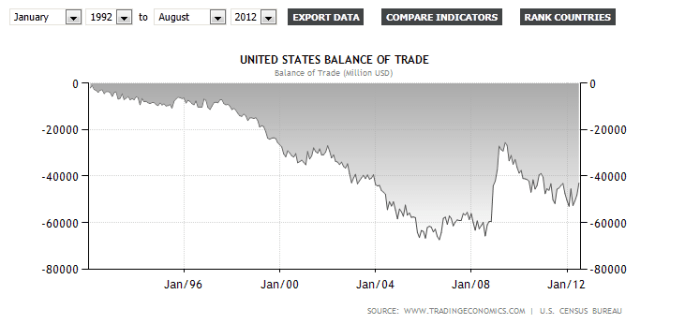
In case you haven’t noticed, food prices are rising everywhere, currencies are being devalued globally, and America doesn’t export anything except papers called “dollars” and “treasuries”. See the chart below. That’s the US trade deficit. What plugs up the hole to bring it back to zero? Paper. When everyone realizes that the paper is actually worthless because America is not good for its debts, the Empire will come crashing down and Tauber will have to follow my advice to leave everyone alone due to complete lack of any alternative.

How to shrink government in Israel step 1: Zero taxes for public employees

I was listening to a lecture by Murray Rothbard the other week about John Maynard Keynes the man. The lecture itself was fascinating, and revealed to me that Keynes referred to himself as an “immoralist” who lectured about the virtues of homosexuality over heterosexuality, actively preferring the former even though he was actually attracted to women. It became clear to me that this man was entirely backwards to the core, and now has the world addicted to the idea that in order to become rich, one has to go into debt.

But there was one thing that stood out that had little to do with Keynes in that lecture. That is, Murray made the offhand remark that public employees – meaning anyone receiving a government paycheck – should not pay any taxes. In fact, public employees are the ones that are living off of private sector tax money, and it makes no accounting sense to have them pay back into the very funds they are living off of.

Instead, public employee pay should simply be reduced by the percentage they would have had to pay in taxes had they been private sector workers. For example, let’s say a Knesset Member gets 20,000 shekels a month and pays 6,000 in withheld income tax, arnona, bitach leumi, and whatever else he pays. Instead, he should simply earn 14,000 shekels period.

What’s the difference? The difference is huge. The fact that public employees “pay taxes” so to speak blurs the line between private and public sectors – between who pays taxes and who consumes them. It makes people think that the tax eaters pay equally into the trough, when in fact that are simply consuming and vomiting back into it. If public employees – ALL of them – paid ZERO taxes – no bituach leumi, no income tax, no arnona (land and property taxes), nothing at all as all these taxes go to fund their salaries anyway, then it would become much clearer who is eating and who is producing. It would give Israel a much better idea of exactly how big their government is and how destructive. And people would start to wake up about what exactly they’re paying and to whom.

Special pay stubs should be made for all public employees that show ZERO withholding. These should be plastered all over the place. They would not be required to file a return at all. They would simply earn less. This means no doctor would pay any taxes, no state-employed Rabbi, no Knesset member, no government clerk, no judge, no police officer, no Shabak agent, not a single active duty soldier, the prime minister, the cabinet, their aids, no child day care employee, no school teacher, no public university professor, no histadrut labor union worker, garbage man, no public radio talk show host, no school administrator should pay a single shekel in taxes of any kind whatsoever from their tax-funded salaries.

They should not feel that they are contributing to the public tax burden, because in fact they are feeding off of it. Every penny of their salaries is tax money. They should understand that very well. And the people of Israel should understand very well just how much of their lives the state runs, how humongous their public sector is.

Only then will it start shrinking.

Is Everyone Else a Slave?

Lately I’ve been thinking a lot about the difference between my life and the lives of others. Rafi talks a lot about freedom from government control, but for me it goes far beyond the government and includes many other controls in society. People don’t realize that they choose their own lives, that they have many options. It’s true that life throws us curve balls sometimes, but we are free to swing at them or not however we choose. I find that oftentimes people live their lives on autopilot and don’t make choices, but then complain about their lives. The problem is very few take responsibility for themselves. Once you do that, you’ll find yourself making better choices and feeling happier about those choices. I’ve learned that autonomy leads to happiness. I know that it works for me.

I don’t live my life according to whatever is considered “normal” and “proper” in society. If what I do happens to be that, it means that I thought it through and chose that way anyway because it fit my life best. For example, I am married and have children, which happens to be very traditional, though maybe less-so today. To me, it works. I love my husband, and I love my children and I love that we can live and grow together and are bound together. I chose this because I thought it was right for me and I value it, not because society told me so. People who choose marriage out of external pressure will probably not be happy.

Let’s begin with values that I have since that is how I make these choices. Some of my values (in no particular order) efficiency, health, environment, family. When there is something that needs to be done, I think about how to do it according to this value and other values that I have. Of course, the values I have listed are pretty broad, but I determine how I live in accordance with how I interpret these values.

How do I make choices in my life that are more efficient? Some big ones include cutting costs around things that I don’t value such as fashion, obsessive cleanliness, toys, various strollers and baby gear that aren’t essential, and other items that have little use in my life. In these areas, we stick to basics. It saves a lot of money and time. Most people have these things because other people have these things and they think that they need them as well. If people really stopped to think about what they actually need to promote their values and what is just acceptable in society, they wouldn’t buy most of the stuff they have. If someone out there has a fashion value, then they would buy stuff in that area, but I assume that most do not, for instance. This type of lifestyle makes me happy, I choose what I need and I don’t worry about all the extra stuff. When I walk in a mall, I am not tempted to buy anything unless I know that I need it. This also ties in with my environment value. Also, another value is that I never buy what I can’t afford, we even hope to amass enough capital to avoid being a slave to a mortgage and are taking measures to achieve that goal.­

Not wasting things we do need is another aspect of efficiency. I use very few disposable items. I use a menstrual cup instead of tampons and pads, my babies wear cloth diapers instead of disposables, we use bathwater and a/c water to flush the toilet (why use clean water to do that?), we rarely use disposable kitchen or dining supplies, we even re-use aluminum foil when possible. We even use the sun for cooking sometimes in our solar oven.

One of my daughter’s favorite activities is to feed the neighborhood goats our compost. This provides educational entertainment, a nice walk, and a bonding experience for us without any cost and it is also good for the environment. When we were a newly married couple before children, our dates consisted of collecting bottles and cans to return for recycling. It was like a real video game, providing us with entertainment, exercise, and even some money while helping to clean up the streets and parks. We would get around the city on our bikes to save time by not sitting in traffic, exercise instead, and get places feeling energized. Now that we don’t live in a city, my husband chooses to hitch a ride to work and run through a field the rest of the way for the same reasons. None of these are the accepted norms, but they work for us and we love what we do.

Some may call us cheap, but sometimes frugality conflicts with other values so we spend our resources on those values such as health, environment, family, and investment in the future. We invested in natural gas tank for our already small and fuel efficient car (1997 Kia Pride). This cost us a lot of money and stress but we see it as an investment since gasoline prices are on the rise and natural gas is cleaner and more abundant. Plus, a large percentage of oil is Arab-controlled.

We also invest in our health, but not like everyone else does. I don’t assume that doctors know what’s best, though I know that there are times when they are useful and necessary. We don’t buy pain-killers, antihistamines, and other drugs, many are endorsed by doctors only because they are given incentives to prescribe them or they are a quick fix. We don’t focus on trying to feel good by alleviating symptoms, we strive to actually be healthy so that we actually do feel good. This is doing research about the source of our ailments and correcting them. It also involves prevention of ailments. We invest in eating a good diet according the primal blueprint using supplements such as fish oil and a multivitamin, and eating simply. My daughters both nurse, also an efficient and natural choice, and I don’t waste resources on another species milk which seems unnecessary to me when I have the proper milk for them readily available and at no cost. This is also related to my family bonding value.

Many people have a career value and good for them, there must be people like that in the world. We don’t. Rafi works in order to support his family, no more than that. I only work when I enjoy it. Otherwise, I do my main job as a woman which is run the household and educate our children. I teach English. In a school like normal teachers? Absolutely not!!! Why not? Too stressful, impossible to teach anything, and not enough money to pry me away from my primary womanly responsibilities. “Feminists” can cringe at my decisions, but I value my role as a woman and love it! Yes, I still need time away to do other things which is why I have side jobs that I enjoy and are worth it. That’s my choice. Others should feel free to choose what makes them happy too. With all the money I save being efficient and not paying for long daycare hours, I can feel free to enjoy myself and my family and still come out in the green each month.

Rafi and I are far from perfect. We know that and don’t pretend to be. We make plenty of mistakes along the road. The difference is that when you think things through and proceed with the mistake, you are more likely to learn and grow from it instead of being trapped in it and blaming others.

Bottom line, I choose my life and I choose my attitude. I choose according to my values, and I am happy with my choices. My life is simple, meaningful, and full of freedom. I can’t complain and I don’t.  Why is this so rare?

I don’t judge others who have values that don’t match my own. I do judge others who do not have any values or who choose to ignore their values.

Here is a challenge for life:

1) Determine what you really value and what you really want from your life.

2) Forget what society does and figure out what you can do to emulate those values.

3) Make choices. Live those choices and learn from them. Don’t complain.

Israel to increase budget deficit; risk economy for buying votes

Today’s Israel Hayom Newspaper: Deficit Widening goes to Government for Vote.

Netanyahu, the fiscal conservative, has decided that it’s a good idea to spend even more money that Israel doesn’t have. Why? Because people want stuff without paying for it. See this clip below from the newspaper.

This is a poll of Israeli citizens. From top to bottom:

Haviv Banai (55): I am against raising taxes. It’s best if they take more money from the tycoons so we wouldn’t have to go into debt.

Eli Lavi (58): If the State needs more money, it’s better to raise taxes rather than widen the deficit.

Doctor David Yishai (57): The economic situation is good and we can relax a bit. We need widen the deficit and not raise taxes.

Doctor Eldad Berkowitz (48): We must not under any circumstances widen the deficit. Be we must not raise taxes either on those who are buckling under the pressure.

Sarah Keidan (56): We don’t need to widen the deficit, but we can raise taxes on the rich and high income earners.

Ra’anan Kahta (33): The State needs to honor its payments and we can only do that by widening the deficit or raising taxes. The treasury will need to find creative ways of getting more money into its coffers.

What’s astounding here is that nobody suggests that perhaps the government should just spend less money. It’s an option that doesn’t even exist according to everyone polled. You either raise taxes or go into debt. If the State says it needs money, then whatever – it needs money and we cannot dispute that.

What about halving the salaries of every Knesset Member? They earn what, 44,000 a month or something? They can’t survive on 22,000? how about every government employee has to pay for his own car and gasoline, just like I do, instead of the government paying for it. How about they pay for their own flights to cockamaymee events where they blow air at people? How about we eliminate the entire Shlav Bet army program from new immigrants where we waste time doing nothing for six months at 50,000 shekels a worthless soldier?

How about limiting the number of ministers in the government? How much do they make a month for doing nothing? Nobody here thinks of these things, because they are all government slaves.

Netanyahu is doing this now because he wants the people yelling in the streets for things from the government to shut up, so instead of cutting his salary, he’s endangering everybody’s income. What happens when you go too deep into debt? Ask Greece. They seem to be doing fine.